How VFDs Save Energy in Pumping and HVAC (with Calculations)
The affinity laws explain why pump and fan VFDs save dramatic energy. Worked example showing 60% energy reduction on a borehole pump retrofit with payback math.
VFDs save energy on centrifugal loads (pumps, fans, blowers) because power consumption scales as the cube of speed. Reduce speed by 20% and you cut power by about 50%; reduce by 50% and you cut power by nearly 90%. Most fixed-speed centrifugal systems are throttled or recirculated to match variable demand — both methods waste energy compared to speed control. This guide shows the math, walks through a worked retrofit example, and presents the payback calculation.
The affinity laws
For a centrifugal pump or fan, three relationships hold approximately:
Related Products
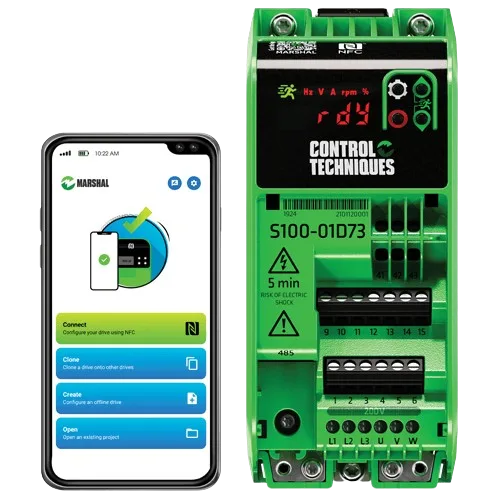
Commander S
Commander S VFD Drives offer energy-efficient motor control for industrial applications. Improve performance and optimise energy usage with reliable Commander S drives.
View Product
Commander C
Commander C VFD Drives from Paneltech Systems provide advanced motor control for industrial and commercial applications. Enhance efficiency and reliability.
View Product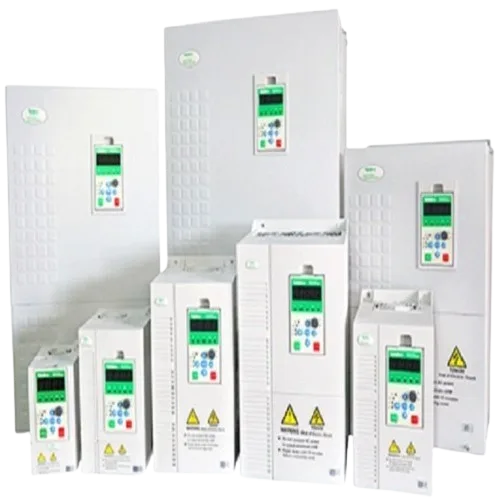
NE-200 Drives
NE-200 Drives offer reliable and efficient performance for industrial applications. Optimise motor speed and energy efficiency with the NE-200 series.
View Product
Elmeasure
Elmeasure smart energy meters for comprehensive energy monitoring, measurement and management in commercial and industrial settings.
View Product- Flow ∝ speed: Halve the speed, halve the flow
- Head (pressure) ∝ speed²: Halve the speed, quarter the pressure
- Power ∝ speed³: Halve the speed, cut power to one-eighth
So if your application only needs 60% of design flow most of the time, the affinity laws say running at 60% speed needs roughly 22% of rated power instead of 100%. That difference is the energy savings.
Comparison: throttling vs VFD
| Required flow | Throttling power | VFD power | Energy saved |
|---|---|---|---|
| 100% | 100% | 100% | 0% |
| 80% | ~85% | ~51% | 34% |
| 60% | ~70% | ~22% | 48% |
| 40% | ~55% | ~6% | 49% |
(Throttling power assumes a pump curve that rises modestly at reduced flow — the exact percentages depend on the pump and system curves. VFD power assumes pure affinity-law operation. Real installations land between the two extremes for fixed-speed and very close to the VFD line for variable-speed.)
Constant-torque vs variable-torque loads
The cube-law savings only apply to variable torque loads — those where required torque drops with speed. Centrifugal pumps, axial fans, centrifugal compressors fit this category.
Constant torque loads — conveyors, positive-displacement pumps, screw compressors, hoists — don't benefit from cube-law savings because torque demand stays roughly constant regardless of speed. VFD retrofits on constant-torque loads still save 5–15% from eliminating throttling losses and reducing motor idling, but the dramatic savings come from centrifugal applications.
Worked example — borehole pump retrofit
| Parameter | Before (fixed speed) | After (VFD) |
|---|---|---|
| Motor rating | 30 kW | 30 kW |
| Pump head | 120 m (design) | 120 m max, modulated |
| Operating profile | On/off cycling | Continuous variable |
| Average operating power | 26 kW (87% of rating) | 14 kW (calculated below) |
| Run hours per day | 10 (intermittent fill cycles) | 22 (low continuous flow) |
| Daily energy | 260 kWh | 308 kWh? — see below |
Step 1: Average flow demand: Reservoir refill demand averages 60% of pump design flow (some days need full flow during peak demand, most days the reservoir top-up is 50–70%).
Step 2: VFD power at 60% speed: 30 kW × (0.6)³ = 30 × 0.216 = 6.5 kW per pump rev. But the VFD doesn't need 60% flow all the time — there's a distribution. Assume the daily-weighted average speed is 70%, giving 30 × 0.343 = 10.3 kW pumping power.
Step 3: Account for VFD efficiency: Modern VFDs are 96–98% efficient at rated load, dropping to 92–94% at light load. Use 95% average: pump-side 10.3 kW / 0.95 = 10.8 kW grid-side.
Step 4: Account for higher run hours: With variable speed, the pump runs continuously instead of cycling. 24 hours × 10.8 kW = 259 kWh — only marginally less than the 260 kWh fixed-speed daily total.
Wait — the savings don't look great. The mistake here is that the fixed-speed pump didn't actually operate at 87% of rating average. It operated at rated power when running and zero when off. The real comparison is to total daily energy delivered, not "while running" energy.
Corrected step 1: Reservoir refill demand = 60% × peak flow × 24 hours = volume of water needed. Fixed-speed delivers this in 10 hours × peak flow = same volume. So fixed-speed daily energy: 30 kW × 10 hours = 300 kWh.
Corrected step 4: VFD daily energy: 10.8 kW × 24 hours = 260 kWh. Savings: 40 kWh/day or 13%.
That's the realistic number for a simple borehole. The savings get larger when the demand profile has wider variation (e.g., agricultural irrigation with peak day vs night) or when fixed-speed operation includes throttling.
Payback math for the retrofit
| Item | Value |
|---|---|
| VFD capital cost (panel + drive + filters) | KSh 220,000 |
| Installation labour | KSh 35,000 |
| Commissioning + 1-year service | KSh 20,000 |
| Total capital | KSh 275,000 |
| Energy savings (40 kWh/day × 365 days) | 14,600 kWh/year |
| Energy cost saving at KSh 23.00/kWh | KSh 335,800/year |
| Simple payback | 10 months |
For higher-variability loads (HVAC chillers, large fans), payback is often 3–6 months. For lower-variability loads, payback stretches to 18–36 months — sometimes hard to justify on energy alone, but the mechanical and process benefits (soft start, no water hammer, precise speed) often tip the case.
Where VFDs save energy by other means
- Eliminating throttling losses: Old systems used valves to throttle pump output — the pump still draws full power, the valve dissipates the excess as heat. VFD speed control eliminates this entirely.
- Reducing standby load: Multi-pump systems with one VFD-controlled lead pump can run at variable speed while the lag pumps stay off — instead of all pumps cycling on/off
- Power factor: VFDs with active front-end provide near-unity power factor on the supply, contributing indirectly to lower energy losses across the supply network
- Reduced motor maintenance: Soft starting eliminates motor inrush stress, extending bearing and winding life
Bottom line
The affinity-law cube relationship explains the dramatic energy savings of VFDs on centrifugal loads. The real-world savings depend on the demand profile — wide-variability loads see the largest savings. For typical Kenyan commercial and industrial centrifugal pump and fan retrofits, paybacks under 18 months are common, with HVAC and irrigation often hitting under 12 months. Constant-torque loads need a different business case (process control, mechanical benefits) but VFDs still pay back.
See our VFD solutions for retrofit feasibility studies, custom drive panels, and on-site commissioning across Kenya.