Industrial Automation Companies in East Africa: SCADA & PLC Integration
Industrial automation companies in East Africa are driving modern manufacturing through PLC systems, SCADA integration, and smart factory solutions. This article explores key technologies, challenges, and the future of industrial automation in the region.
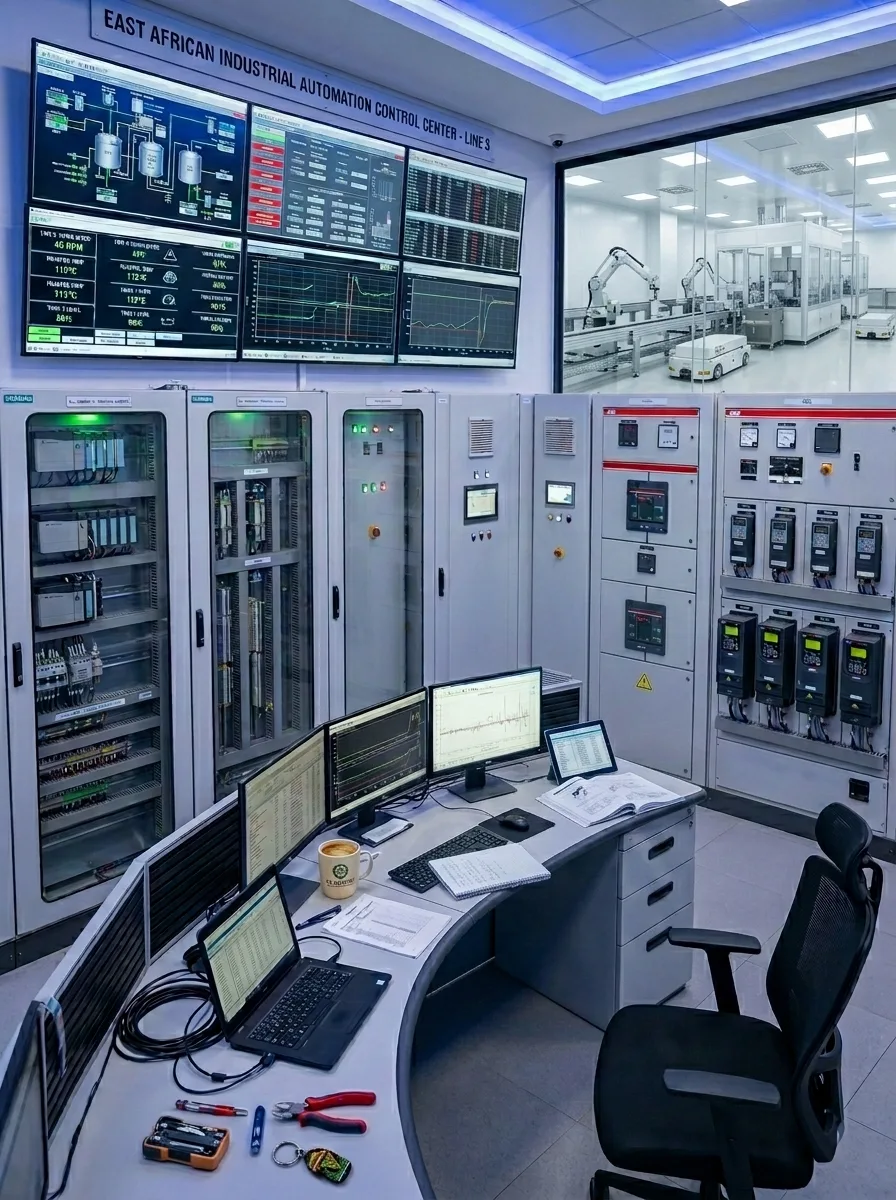
Industrial automation is rapidly reshaping manufacturing, energy, water treatment, and processing industries across East Africa. From Nairobi’s manufacturing hubs to industrial zones in Tanzania and Uganda, companies are increasingly adopting PLC programming, SCADA systems, and integrated control systems to improve efficiency and reduce operational downtime.
In this article, we explore what defines leading industrial automation companies in East Africa, the technologies they deploy, and how businesses can evaluate the right engineering partner for long-term reliability and scalability.
Related Products

PLC Automation Panels
Advanced PLC automation panels for intelligent control of industrial processes, tailored to your operational requirements.
View Product
UTC 3202
Multispan UTC 3202 timer relay with multiple timing modes for versatile control applications in industrial automation.
View Product
Distribution Boards
Distribution boards divide the main electrical power supply into smaller circuits while providing circuit protection for residential, commercial and industrial applications.
View Product
Feeder Pillar Panels
Feeder pillar panels providing reliable power distribution solutions for outdoor and indoor industrial and commercial applications.
View ProductWhat Do Industrial Automation Companies in East Africa Do?
Industrial automation companies in East Africa design, implement, and maintain PLC-based control systems, SCADA platforms, and industrial instrumentation that automate production processes. They improve efficiency, reduce human error, and enable real-time monitoring of industrial operations.
These systems are often integrated with electrical infrastructure such as low voltage control systems and switchgear panels to ensure stable operation.
Explore related infrastructure solutions:
Why Is Industrial Automation Growing in East Africa?
Industrial automation is growing in East Africa due to rising manufacturing demand, energy efficiency needs, and the push for digitally controlled industrial systems that reduce operational costs.
Regional growth drivers include:
- Expansion of industrial parks in Kenya and Ethiopia
- Rising electricity costs requiring optimized power usage
- Government industrialization programs (e.g., Kenya Vision 2030)
- Increased demand for manufacturing consistency
Automation systems often rely on stable power infrastructure such as:
What Technologies Do Automation Companies Use?
Automation companies in East Africa use PLCs, SCADA software, VFD drives, industrial sensors, and HMI interfaces to create fully integrated control systems.
Key Technologies:
- PLC control systems
- SCADA monitoring platforms
- VFD motor control systems
- Industrial instrumentation
These technologies depend heavily on proper electrical design and panel engineering. Learn more about integrated systems at:
What Makes a Good Industrial Automation Company?
A strong automation company delivers reliable PLC programming, SCADA integration, and custom control panel design aligned with IEC engineering standards.
Key capabilities include:
- Custom control panel manufacturing
- PLC programming and commissioning
- SCADA dashboard configuration
- Industrial electrical integration
These systems are often built inside engineered control enclosures such as:
Industrial Automation Challenges in East Africa
Industrial automation in East Africa faces challenges such as unstable power supply, limited skilled PLC engineers, and high dependency on imported automation hardware.
Common issues include:
- Voltage fluctuations affecting PLC stability
- Limited local manufacturing of automation components
- High cost of SCADA and PLC hardware
These challenges make electrical stabilization systems critical:
System Integration in Modern Industrial Plants
System integration connects PLCs, SCADA platforms, sensors, and electrical panels into a unified control system that enables real-time monitoring and automation.
A typical setup includes:
- Input sensors
- PLC logic controllers
- SCADA monitoring systems
- VFD-driven motors
- Protection and switching systems
Explore integration components:
Future of Industrial Automation in East Africa
The future of industrial automation in East Africa is driven by smart factories, IoT-enabled systems, and predictive maintenance powered by data analytics.
Emerging trends:
- Industry 4.0 adoption
- Cloud-based SCADA systems
- AI-driven predictive maintenance
- Smart energy optimization
Industrial automation will increasingly depend on integrated electrical ecosystems built by engineering firms like Panel Tech Systems:
Conclusion
Industrial automation companies in East Africa are transforming manufacturing and infrastructure by enabling smarter, more efficient, and more reliable production systems. Through PLC programming, SCADA integration, and advanced electrical engineering, industries can achieve higher productivity and reduced downtime.