Solar ACDB vs DCDB Explained: DC Combiner Box vs AC Switchgear Guide
Solar ACDB vs DCDB explained for commercial PV systems. Learn the difference between DC distribution boards and AC switchgear, their functions, protection roles, and where each is installed in solar installations.
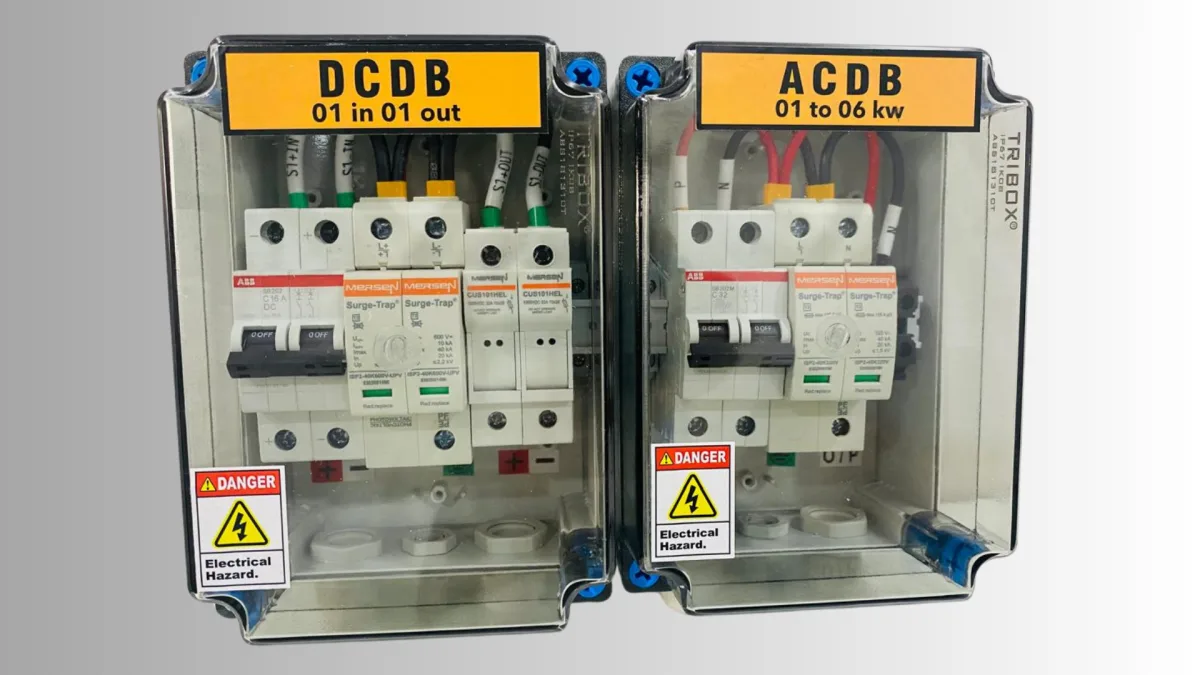
Solar photovoltaic (PV) systems are not just panels and inverters—they are carefully engineered electrical networks that require structured protection at both DC and AC stages. Two of the most critical components in this protection architecture are the DC Distribution Board (DCDB) and the AC Distribution Board (ACDB).
In Kenya’s growing solar market—ranging from Nairobi commercial rooftops to off-grid systems in Rift Valley farms—incorrect or missing protection devices are one of the leading causes of inverter failure, fire hazards, and system inefficiency.
This guide explains the functional difference between ACDB and DCDB, where each is installed, and why both are mandatory in professional solar installations.
What is a Solar DCDB (DC Distribution Board)?
A DC Distribution Board (DCDB) is a protection and distribution panel installed on the DC side of a solar PV system, between the solar panels and the inverter. It protects the inverter and PV array from DC faults such as overcurrent, reverse polarity, and surge events.
The DCDB acts as the first electrical protection layer after solar panels generate electricity.
DCDB is typically installed:
- Between solar panels (PV array) and inverter
- Close to the solar array or combiner box
- On the DC input side of the system
DCDB System Diagram (Text-Based)
[ SOLAR PANELS / PV ARRAY ]
            ↓
   (DC CABLES FROM STRINGS)
            ↓
        [ DCDB ]
   - DC MCB / Fuses
   - DC SPD (Surge Protection)
   - String Combiner Inputs
            ↓
       [ INVERTER ]
Functions of DCDB
The DCDB protects the inverter and DC cabling by isolating faults, limiting surge damage, and combining multiple PV strings safely. It ensures stable and safe DC power delivery into the inverter.
Key functions include:
- DC overcurrent protection
- String isolation and switching
- Surge protection (lightning & transient spikes)
- Reverse polarity protection
- DC cable distribution management
Why DCDB is Critical in Kenya
Kenya experiences frequent lightning activity in regions such as Rift Valley and Western Kenya. Without proper DC surge protection, PV systems are highly vulnerable to:
- Inverter burnout
- PV string damage
- Cable insulation failure
- Fire hazards in combiner boxes
What is a Solar ACDB (AC Distribution Board)?
A Solar AC Distribution Board (ACDB) is a protection panel installed on the AC output side of the inverter. It distributes and protects AC power before it is supplied to loads or the grid.
The ACDB is the final protection layer between the solar system and electrical loads.
ACDB System Diagram (Text-Based)
[ INVERTER OUTPUT (AC) ]
            ↓
        [ ACDB ]
   - AC MCB / MCCB
   - AC Surge Protection Device
   - Isolation Switch
            ↓
     [ LOADS / GRID PANEL ]
   - Lighting circuits
   - Industrial loads
   - Distribution boards
Functions of ACDB
The ACDB protects downstream electrical loads and ensures safe distribution of inverter-generated AC power. It isolates faults and prevents system-wide shutdowns due to AC-side disturbances.
Key functions include:
- AC overcurrent protection
- Short circuit protection
- Surge protection on AC side
- Isolation of inverter output
- Load distribution control
ACDB vs DCDB: Core Differences
The key difference is that DCDB protects the solar panels and inverter on the DC input side, while ACDB protects electrical loads on the inverter output side. They operate at different stages of the energy conversion process.
| Feature | DCDB | ACDB |
|---|---|---|
| Position | Before inverter | After inverter |
| Current Type | DC (Direct Current) | AC (Alternating Current) |
| Protection Target | PV array & inverter input | Electrical loads & distribution |
| Devices Used | DC fuses, DC MCB, DC SPD | AC MCB, MCCB, AC SPD |
| Voltage Level | 600–1500V DC typical | 230V / 415V AC |
| Main Function | PV protection & string management | Load protection & distribution |
Why Both ACDB and DCDB Are Required
Both ACDB and DCDB are required because solar systems operate in two electrical domains—DC generation and AC consumption. Each side requires specialized protection to ensure system safety and reliability.
Without DCDB:
- Inverter is exposed to PV surge damage
- No string-level fault isolation
- High fire risk during lightning events
Without ACDB:
- No protection for appliances and loads
- Risk of grid-side faults damaging inverter
- Unsafe distribution of AC power
In professional installations in Kenya, both are mandatory under IEC-based solar design practices.
DC Combiner Box vs DCDB
A DC combiner box is used to merge multiple PV strings, while a DCDB adds protection devices and isolation components to the combined DC output. DCDB is a more complete protective and distribution solution.
DC Combiner Box:
- Combines PV strings only
- Basic fusing
- Limited protection
DCDB:
- Combines PV strings
- Includes DC breakers, SPDs, isolators
- Provides full protection architecture
Internal Components of ACDB and DCDB
ACDB and DCDB both contain protective and switching devices designed to isolate faults and ensure safe power distribution. Each component plays a specific role in electrical safety.
DCDB Components:
- DC circuit breakers (MCB/MCCB)
- DC fuses per string
- DC surge protection device (SPD)
- DC isolator switch
- Terminal blocks
ACDB Components:
- AC MCB/MCCB
- AC surge protection device
- Changeover or isolation switch
- Busbars and distribution terminals
System Specifications for Solar ACDB & DCDB
Solar ACDB and DCDB systems are designed according to IEC standards to ensure safe operation under high voltage and environmental stress conditions. They are engineered for reliability in outdoor and industrial environments.
System Specifications Table
| Parameter | DCDB | ACDB |
|---|---|---|
| Rated Voltage | 600–1500V DC | 230V / 415V AC |
| Frequency | N/A | 50Hz |
| Protection | DC MCB, fuses, SPD | AC MCB, MCCB, SPD |
| Enclosure Rating | IP65 (outdoor) | IP54–IP65 |
| Standards | IEC 62548 | IEC 61439 |
| Mounting Type | Wall / Pole mounted | Wall mounted |
| Application | PV array protection | Load distribution |
Kenya-Specific Solar Engineering Considerations
Solar systems in Kenya must account for lightning activity, humidity, dust, and grid instability, making ACDB and DCDB protection essential for system durability. Proper design ensures long-term reliability and compliance with local conditions.
Environmental Challenges:
- High lightning exposure (Western Kenya, Rift Valley)
- Coastal humidity (Mombasa corrosion risk)
- Dust in dry regions affecting insulation
- Grid fluctuations affecting inverter stability
Engineering Solutions:
- High-quality SPDs on both AC and DC sides
- IP65-rated enclosures for outdoor installations
- Proper earthing and grounding systems
- Surge coordination between DCDB and ACDB
Integration with Solar Inverters
ACDB and DCDB are directly integrated with solar inverters to ensure safe energy conversion and distribution. They protect the inverter from both input and output electrical disturbances.
Flow of Energy:
SUN → PV PANELS → DCDB → INVERTER → ACDB → LOADS / GRIDThis ensures:
- Controlled DC input
- Safe energy conversion
- Protected AC distribution
Explore solar-related systems:
products
#solar-ac-db-combiner
Common Installation Mistakes
Incorrect installation of ACDB and DCDB can lead to system failure, fire hazards, and inverter damage. Proper engineering design is essential for system safety and performance.
Common Mistakes:
- Missing DC surge protection
- Undersized AC breakers
- No proper earthing system
- Combining AC and DC wiring improperly
- Using AC-rated devices on DC circuits
Future of Solar Protection Systems
Solar protection systems are evolving into smart, IoT-enabled monitoring panels that track voltage, current, and surge events in real time. This will significantly improve predictive maintenance and system reliability.
Emerging Trends:
- Smart DCDB with remote monitoring
- IoT-enabled ACDB panels
- Integrated inverter + protection systems
- AI-based fault prediction in solar arrays
Kenya’s commercial solar sector is gradually adopting these advanced systems for improved efficiency and safety.
Conclusion
ACDB and DCDB are not optional accessories—they are essential protection layers in every professional solar PV installation. DCDB safeguards the solar generation side, while ACDB protects the consumption and distribution side.
Together, they ensure that solar systems in Kenya operate safely, efficiently, and reliably under challenging environmental and grid conditions.
Contact Paneltech Systems Ltd
Powering Kenya's Future with Reliable Electrical Solutions
Email: [email protected]
Phone: 0799 531765
Location: Nairobi, Kenya
Website: https://paneltechsystems.co.ke/
Our Specialized Services:
Low Voltage (LV) Panels & APFC Panels
VFD Drive Solutions & ATS / MTS Systems
Solar Power & EV Charging Infrastructure
Electrical Supplies & Engineering Consultations