Commander & NE-200 VFD Drive Range and VFD Panels
Commander C, Commander S and NE-200 variable frequency drives, plus custom VFD panels with line reactors, EMC filters and bypass options.
A variable frequency drive (VFD) controls the speed and torque of an AC motor, most often a three-phase induction motor, by varying the frequency and voltage it supplies. Drive systems are covered by the IEC 61800 series, with EMC requirements in IEC 61800-3. In Kenya, VFDs run borehole and booster pumps, HVAC fans, conveyors and process machinery.
Panel Tech Systems supplies Commander C, Commander S and NE-200 Drives, and integrates ABB ACS, Schneider Altivar, Siemens SINAMICS and Danfoss VLT drives into custom panels on request. Our VFD drive panels range from 0.75 kW pump and fan drives up to 500 kW process drives, and can include input line reactors, EMC filters, dV/dt or sine-wave output filters, bypass arrangements, forced ventilation or air-conditioning, and PLC integration. For design, installation and commissioning, see our VFD drive solutions service. For pump station and treatment plant applications, see our water utilities page.
Products in this Range
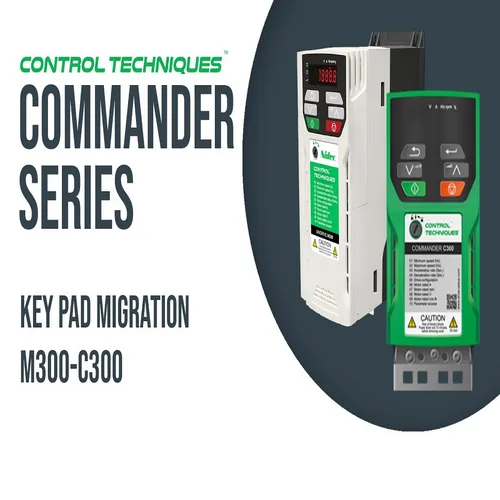
Commander C
Commander C VFD Drives from Paneltech Systems provide advanced motor control for industrial and commercial applications. Enhance efficiency and reliability.
View Details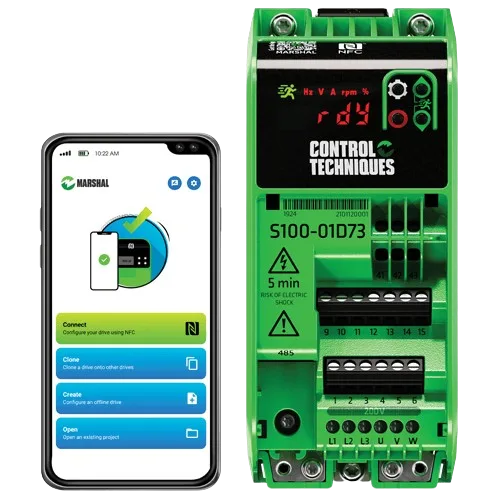
Commander S
Commander S VFD Drives offer energy-efficient motor control for industrial applications. Improve performance and optimise energy usage with reliable Commander S drives.
View Details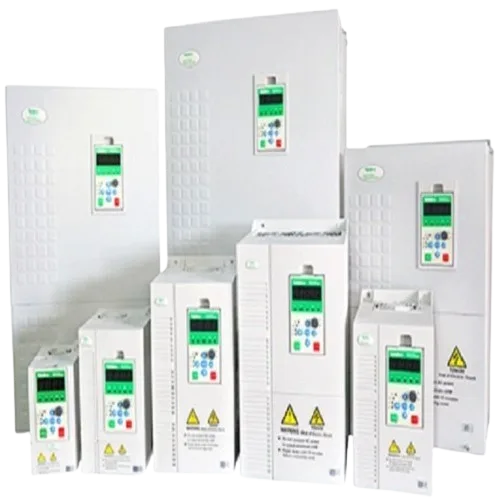
NE-200 Drives
NE-200 Drives offer reliable and efficient performance for industrial applications. Optimise motor speed and energy efficiency with the NE-200 series.
View DetailsVFD panel options compared: what each component does and when to specify it
| Option | What it does | When to specify | Trade-off |
|---|---|---|---|
| AC line reactor or DC choke | Reduces input current harmonics and supply transients | Most installations; the usual minimum harmonic measure | Small voltage drop; adds heat and panel space |
| Passive harmonic filter | Tuned circuit absorbing low-order drive harmonics | Larger drives where reactors alone are not enough | Can turn capacitive at light load; size carefully |
| Active harmonic filter | Injects current that cancels measured harmonics | Many drives on one busbar, or generator-fed sites | Highest cost; needs space and cooling |
| EMC (RFI) filter | Cuts conducted high-frequency emissions to IEC 61800-3 category limits | Shared or residential supplies; sensitive equipment nearby | Raises earth leakage current; check RCD selection |
| dV/dt output filter | Slows voltage rise time at the motor terminals | Long motor cables or older motor insulation | Some voltage drop; only moderate cable-length extension |
| Sine-wave output filter | Smooths PWM output to near-sinusoidal voltage | Very long cables, submersible pumps, step-up transformers | Bulky and costly; voltage drop reduces available torque |
| Bypass (DOL or soft starter) | Runs the motor at fixed speed if the drive fails | Critical pumps or fans without a standby motor | Full inrush on DOL bypass; needs interlocking |
| Forced ventilation or air-conditioning | Removes drive heat losses from the enclosure | Hot ambients, sealed enclosures, larger drives | Filter maintenance; air-conditioning adds energy use |
How to Choose: VFD Drive Panels
1. Start from motor nameplate current, not kW
Size the drive so its continuous output current is at least the motor's full-load current (FLC) at your supply voltage. The kW figure on a drive label is usually based on a standard four-pole motor. Slow-speed, rewound or high-slip motors can draw more current for the same kW. Where one drive feeds several motors, run it in V/f (scalar) control, size it for the sum of their FLCs, and give each motor its own overload protection. Our VFD sizing guide works through the steps.
2. Match the duty rating to the load
Centrifugal pumps and fans are variable-torque loads and can use a drive's normal-duty rating. Conveyors, mixers, crushers, positive-displacement pumps and hoists are constant-torque loads. They need the heavy-duty rating, which gives a higher short-term overload and stronger low-speed torque. High-inertia loads that must stop quickly usually also need a braking resistor, and so do hoists. A self-cooled motor run at low speed on a constant-torque load may need forced cooling.
3. Derate for altitude, temperature and enclosure
Most drives deliver full output only up to 1,000 m above sea level. Nairobi and much of the highlands sit well above that, so apply the manufacturer's altitude derating. Also check derating for ambient temperature and switching frequency, and size panel ventilation or air-conditioning for the drive's heat losses. Choose the enclosure IP rating (IEC 60529) for the site: an outdoor pump-head cabinet needs far more protection than a drive in a clean switchroom.
4. Plan harmonics and EMC from the start
- Harmonics: a standard six-pulse drive draws non-sinusoidal current. A line reactor or DC choke is the usual minimum. Passive or active filters, or low-harmonic drives, suit plants where drives are a large share of the load or where a generator supplies the site. See VFD harmonic mitigation options compared.
- EMC: IEC 61800-3 defines categories C1 to C4. Drives on low-voltage supplies shared with residential premises (the first environment) need category C1 or C2 performance. Dedicated industrial networks (the second environment) typically accept C3.
- Motor cable: use screened motor cable with 360-degree termination at both ends. Add a dV/dt or sine-wave filter where the run exceeds the drive manufacturer's cable-length limit.
5. Decide whether you need a bypass
For critical pumps and fans, a bypass lets the motor run direct-on-line or through a soft starter if the drive fails. The bypass and drive-output contactors must be electrically and mechanically interlocked so mains voltage can never reach the drive's output terminals. The motor also needs its own overload protection in bypass mode. Drives, starters and bypass gear are often housed together in a motor control panel.
6. Define control and integration
List the control signals before ordering. The options are keypad only, hardwired start/stop with a speed reference (for example 4-20 mA from a pressure transmitter), or a fieldbus link to a PLC or SCADA system. Where several drives must be sequenced, as in booster pump sets, specify the controller with the panel. See our PLC automation panels.
7. Check the savings case
On centrifugal loads, shaft power varies roughly with the cube of speed, so a 20% speed reduction cuts theoretical power to about half. Real savings are lower where static head is high, as in many boreholes, so base the business case on the measured duty profile. Our guide on how VFDs save energy includes worked calculations.
Send us the motor nameplate details, load type, supply arrangement and site conditions through our contact form, or call 0799 531765. Our engineers will recommend a drive and panel configuration and prepare a quotation.
Technical Guides
How to Size a VFD for a 3-Phase Motor: A 6-Step Engineer's Guide
Step-by-step VFD sizing covering motor full-load current, starting torque, duty cycle, ambient derating, harmonics, and cable-length considerations. With worked example.
Read guideVFD Harmonic Distortion: Mitigation Options Compared
VFDs inject 5th, 7th, 11th, and 13th harmonics into the supply. This guide compares line reactors, passive filters, active filters, and multi-pulse drives against IEEE 519 and IEC 61000-3-12 limits.
Read guideHow VFDs Save Energy in Pumping and HVAC (with Calculations)
The affinity laws explain why pump and fan VFDs save dramatic energy. Worked example showing 60% energy reduction on a borehole pump retrofit with payback math.
Read guideVFD vs Soft Starter vs DOL: Which Motor Starter for Your Load?
A practical engineer's guide to choosing between Variable Frequency Drives, soft starters, and Direct-on-Line starting. Covers inrush current, energy savings, mechanical stress, and process control trade-offs.
Read guideVFD Installation Best Practices: Layout, Cabling & Earthing for Industrial Motor Systems
Learn VFD installation best practices for industrial facilities. Discover variable frequency drive wiring standards, panel layout requirements, cable routing methods, and electrical panel earthing for VFDs to reduce EMI and improve reliability.
Read guideCommon VFD Faults: VFD Troubleshooting Guide for Overcurrent and Undervoltage
Need a VFD troubleshooting guide? Learn how to identify and troubleshoot common variable frequency drive fault codes including overcurrent trips, undervoltage, overvoltage, overheating, and earth faults in industrial VFD panels.
Read guideFrequently Asked Questions: VFD Drive Panels
Need VFD Drive Panels for your project?
Talk to our engineers about specification, availability and delivery across Kenya.